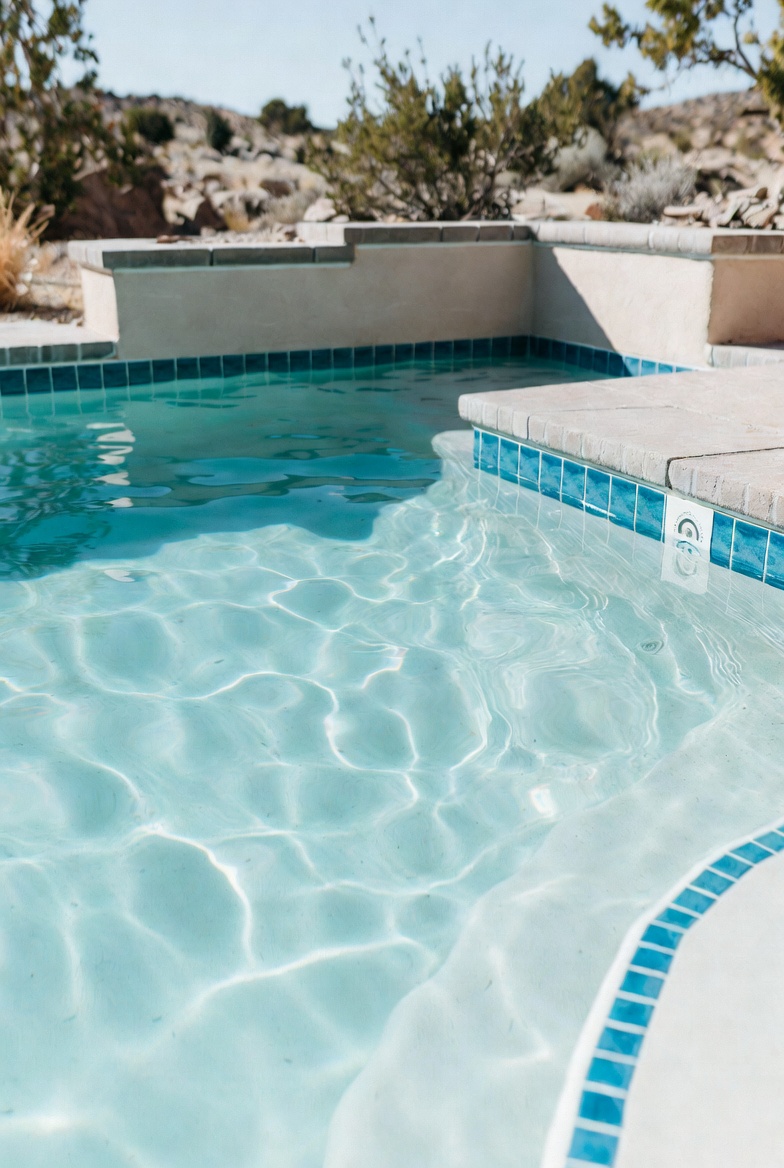
PebbleTec and pebble-aggregate finishes hold up best in St. George's hard water — the stone aggregate doesn't dissolve the way plaster does.
Quartz is the strong middle option. Quartz aggregate resists dissolution better than pure plaster while costing less than pebble. Standard white plaster is the most vulnerable.
What hard water actually does to a pool
"Hard water" means water with high dissolved mineral content — mostly calcium and magnesium. In a swimming pool, hard water creates two problems that work in opposite directions, and you have to manage both.
- Scaling. Calcium deposits build up on the pool surface — visible as a chalky band at the waterline, or as rough patches on walls and floor. Scale traps stains, hides leaks, and is hard to remove without abrasive cleaning.
- Dissolution. If the water's calcium hardness drops too low (below ~200 ppm), the water becomes aggressive and starts pulling calcium out of the pool surface. That's literally the plaster dissolving back into solution.
St. George water arrives at your pool already high in calcium. Add evaporation (you lose water, but the minerals stay), and calcium hardness creeps up year over year. So most pools here drift toward scaling, not dissolution — but pH swings can briefly tip the water aggressive, and that's when damage happens fast.
St. George water chemistry, by the numbers
Typical St. George municipal water values, measured at the tap:
| Measure | St. George tap | Pool target range |
|---|---|---|
| Calcium hardness | 200–340 ppm | 200–400 ppm |
| Total alkalinity | 120–180 ppm | 80–120 ppm |
| pH | 7.8–8.2 | 7.4–7.6 |
| Dissolved solids (TDS) | 400–600 ppm | Under 1,500 ppm |
| Cyanuric acid (added by you) | 0 ppm at tap | 30–50 ppm in pool |
The trouble spots: alkalinity and pH both arrive high, which means you're adding acid frequently to bring them down to range. Over time, repeated acid additions push the water toward aggressive — which is what eats plaster.
Finishes ranked by hard-water resilience
Here's the rough ranking, based on how each finish handles St. George's water profile:
- PebbleTec / pebble finishes — best resistance. Pebble aggregate is inert stone; it doesn't dissolve. The cement matrix between pebbles is still vulnerable, but the surface as a whole holds up dramatically longer.
- Glass bead finishes — also excellent. Glass is even more chemically inert than pebble. Premium tier; harder to find local crews experienced with it.
- Quartz finishes (Diamond Brite, StoneScapes, Colorquartz) — strong middle option. Quartz aggregate resists dissolution; the surrounding plaster is still vulnerable but lasts longer than pure plaster.
- Tinted plaster — comparable to white plaster for durability; the dye holds color slightly longer than white plaster shows wear.
- Standard white plaster — most vulnerable. The entire surface is cement-based and dissolves into the water over time.
- Fiberglass gelcoat — different conversation. Gelcoat doesn't dissolve in the same way plaster does, but it oxidizes and chalks under UV. Resilience is good for the first 8–10 years, then drops.
Why pebble wins in St. George
Three things make pebble finishes the durability winner here:
- Inert aggregate. The pebble itself isn't going anywhere. Even as the cement matrix slowly degrades, the pebble surface stays intact and visually unchanged.
- Texture masks scale. Calcium scale that would be obvious on smooth white plaster is barely visible on a variegated pebble surface.
- Better chemistry tolerance. Brief pH excursions that would etch plaster typically don't damage pebble. You have more margin for error in maintenance.
The trade-off is cost and feel. Pebble runs roughly 2× the price of plaster. Classic PebbleTec has noticeable texture some bare feet don't love (PebbleSheen and PebbleFina are smoother).
What you can do regardless of finish
Finish choice matters, but maintenance matters more. These habits extend the life of any finish in St. George:
- Keep calcium hardness 250–350 ppm. Too high causes scale; too low causes dissolution. Test monthly.
- Keep pH 7.4–7.6. Drift up and you scale; drift down and you etch.
- Watch alkalinity. Aim for 80–120 ppm. St. George water arrives high; you'll be adding acid to bring it down.
- Drain and refill every 3–5 years. Lets you reset accumulated TDS and cyanuric acid.
- Brush weekly. Removes loose scale before it builds up.
- Don't shock the pool with high pH or temperature swings. Rapid changes are what crack and etch surfaces, not steady-state chemistry.
A qualified local licensed contractor will contact you to get your quote started. No obligation.
Frequently asked questions
Is St. George water really worse for pools than other markets?
Measurably yes. National average pool plaster lifespan is 10–15 years; in St. George it's 7–10. The driver is the combination of hard water, intense UV, and high evaporation that concentrates minerals.
Can I install a water softener for my pool?
Generally not recommended. Softeners remove calcium and replace it with sodium — but pool water needs calcium for the surface to stay stable. You'd be making the water aggressive and accelerating surface dissolution.
Does pebble cost more to maintain than plaster?
No — pebble actually costs slightly less to maintain. Chemistry is similar, but pebble tolerates minor swings better, and it doesn't show staining and scaling the way plaster does.
Is there a hard-water-friendly plaster?
Some manufacturers blend additives (microsilica, calcium aluminate) into plaster to improve hard-water resistance. The improvement is real but modest — maybe 1–2 extra years of life. Not enough to change the basic ranking above.
Free quote for your pool.
A qualified local licensed contractor will contact you to get your quote started. No pressure, no obligation.
Get My Quote