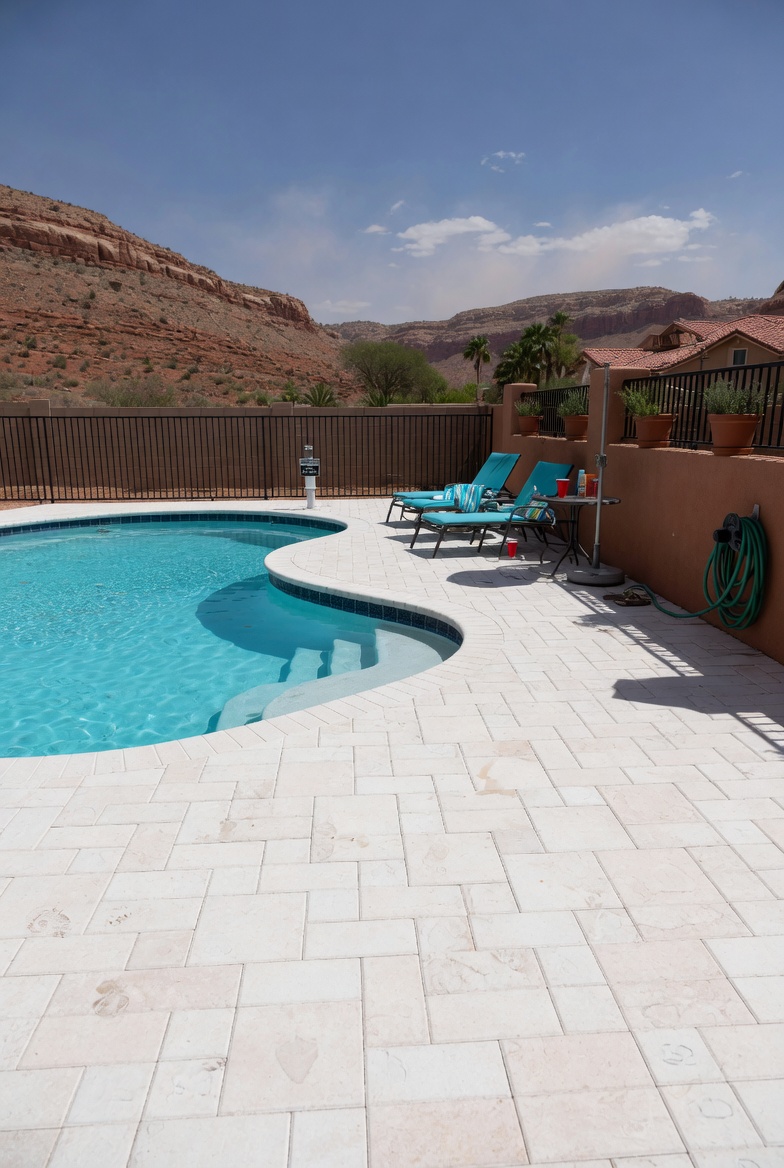
Pavers turn a basic concrete deck into a finished, premium pool surround — cooler underfoot, longer-lasting, and a much stronger fit for St. George's red-rock landscape than poured concrete.
Three reasons pavers win in this market: (1) travertine and natural stone run 20–40°F cooler than dark concrete in summer — a big deal when your deck hits 130°F+ in July; (2) they tie directly into the red-rock and sandstone aesthetic that defines Southern Utah landscaping; (3) individual pavers can be replaced if cracked, unlike a poured slab. Long-term, they outlast every other deck material. For the full comparison vs. Kool Deck and coatings, see our deep-dive: Pool Deck Resurfacing with Pavers in St. George.
Pavers can be laid over an existing concrete deck (if it's structurally sound), set on a compacted base for a new install, or used selectively for accent borders around a pool's coping. Many St. George installs use pavers around the immediate pool perimeter and transition to scored concrete or landscaping further out.
Site prep, removal or grading of existing surface as needed, base layer (compacted gravel + sand for new installs; bond coat for over-concrete installs), paver installation with proper joint spacing, joint filling (sand or polymeric), and sealing. Most installs include edging to keep pavers from migrating over time.
Quick form. A qualified local licensed contractor will contact you to get your quote started.
Most pool paver projects fall between $4,000 and $18,000 depending on material and area. Concrete pavers typically run $8–$14 per square foot installed. Travertine and brick run $12–$22. Natural stone $18–$35. Most St. George residential paver decks land in the $7,000–$12,000 range.
Yes — and it's a common St. George approach. The existing concrete acts as a stable base; pavers are bonded with mortar or set on a thin sand layer. The deck must be structurally sound (no major cracks or movement) — a contractor will tap-test before quoting.
Travertine and lighter natural stones stay 20–40°F cooler in summer than dark broom-finished concrete. Light-colored concrete pavers also run cooler than dark slabs. If hot decks are your reason for resurfacing, pavers are a meaningfully better answer than acrylic coatings.
20+ years for quality installs, often 30+ with re-sanding joints every 3–5 years and periodic sealing. Individual damaged pavers can be lifted and replaced without disturbing the rest — a major advantage over poured concrete.
Tumbled travertine and textured concrete pavers actually provide better wet grip than smooth poured concrete. Polished or honed finishes can be slick — ask your installer for a hand sample before choosing a finish.
Less than you'd think — most St. George installs use polymeric jointing sand that hardens and resists weed germination. Periodic resealing keeps it tight. Traditional sand joints need more maintenance.
Tell us about your pool. A qualified local licensed contractor will contact you to get your quote started.